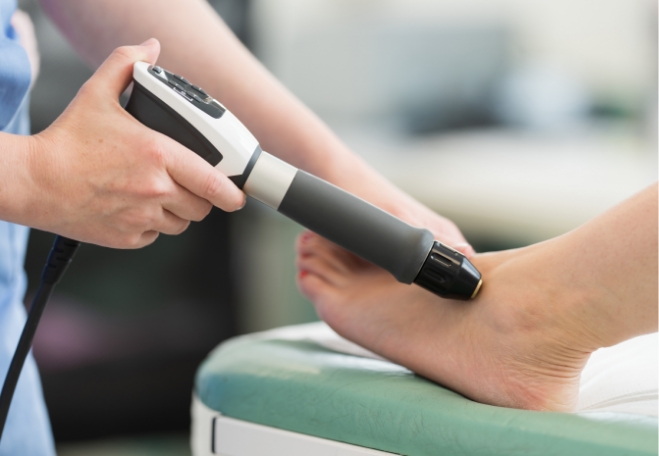
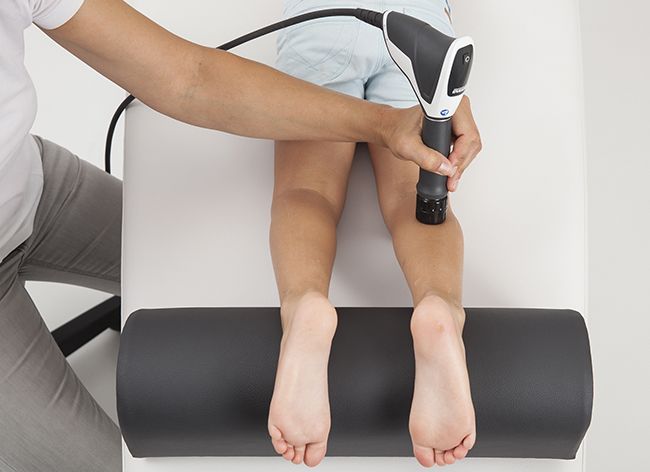
Shock waves
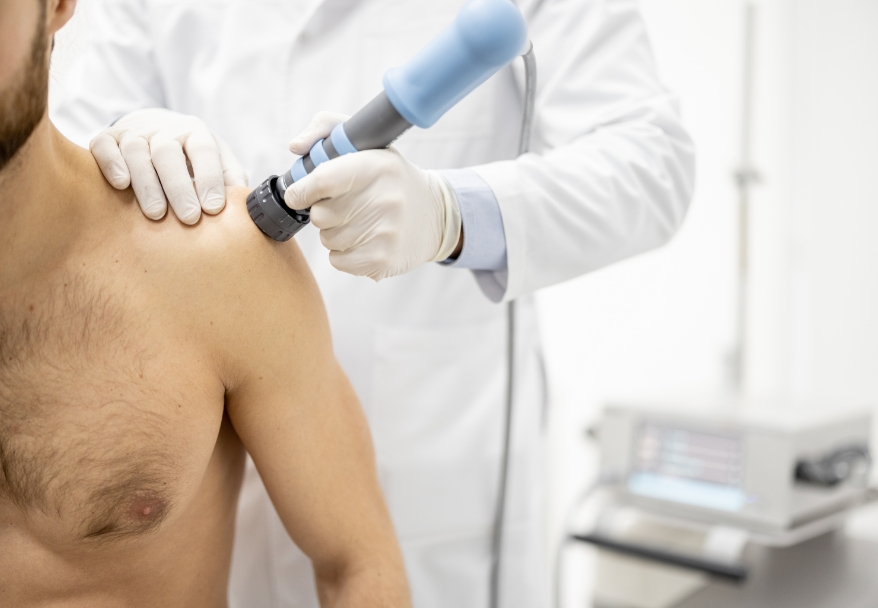
It is a method developed more than 20 years ago for the treatment of musculoskeletal pathologies in the field of orthopedics.
It is effective in the treatment of musculoskeletal and aesthetic pathologies.
Biological effects of shock waves
- Cellular: Increased transmission at the cell membrane level, improving the activity of ion channels, stimulation of cell division and stimulation of cytokine production.
- Angiogenesis of vessels at the tendon and muscular level: improvement of blood circulation, increased concentration of beta-1 growth factor and stimulation of processes on osteoblasts.
- Bone healing and re-modeling.
- Improved micro-circulation and metabolism.
- Dissolution of calcified fibroblasts.
- Catalyst in collagen production.
- Reduction in tissue tension.
- Analgesic effect
Advantage
- Due to the targeted application of shock waves, the stress to the surrounding tissues is practically nil.
- The patient is not overloaded with medication, except for the short-term effect of local anesthesia, if used.
- The possibility of preventing a hypothetical surgical intervention and its side effects.
- Thanks to outpatient treatment, absenteeism is reduced to a minimum.
- For some indications such as epicondylitis or "tennis elbow" it is currently considered the treatment of choice from a physiotherapy point of view.
Possible side effects
- Temporary erythema or swelling in the treated area.
- Loss of body sensation or temporary itching in the treated area.
- Hematoma.
- Appearance of petechiae.
- Skin damage after previous corticoid treatment.
- Undesirable cardiac activity immediately after application of therapy.
DIFFERENCES between waves of shock Radials and FOCALS
-
Radials
The energy is dispersed from the applicator to the tissues. - Maximum pressure near the head.
- Lower depth penetration.
- They act on large areas.
- They are usually used to treat muscles, superficial tendons, and painful spots.
-
FOCALS
Energy converges at a focal point or volume. - They allow to concentrate the energy to a certain depth.
- They reach deeper tissues, depending on the team.
- They treat more localized areas.
- They are used, for example, in deep tendon lesions and certain bone pathologies.
Instruction
- Plantar fasciitis
- Tendon inflammation / Bursitis Achilles tendon
- Inflammation and calcification of the tendons in the shoulder joint
- Epicondylitis and epitrocleitis
- Patella syndrome (Apex patellae syndrome) and tibial stress syndrome (tibial stress syndrome)
- Patellar tendinitis
- Pain in the hamstrings of the hamstrings
- Pain in the palmar area of the wrist joint
- Exostosis of small joints of the hand (grade 1).
- Pain in trigger points or muscle areas